Security and reproducibility
Bitcoin-Safe follows a high standard for binary security: reproducible builds, signed commits, signed releases, and independent external monitoring.
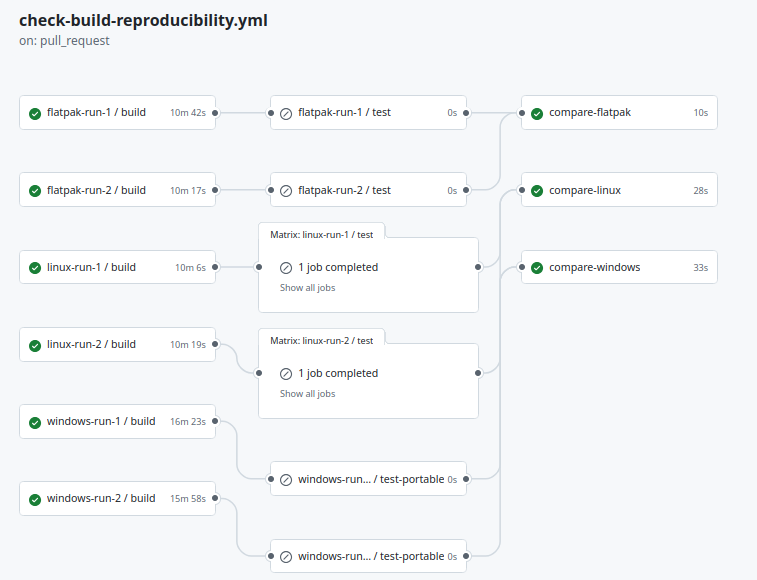
We implemented multiple ways to protect the integrity of the downloads on the website, so the app you download really matches the public source code:
- Reproducible builds: Linux
deb,AppImage, andFlatpakbuilds, plus Windowsportable exeandsetup exe, can be reproduced byte-for-byte. If a rebuilt file matches exactly, that is strong evidence that the binary was built from the same source code. - Signed repository history: the Bitcoin-Safe GitHub repository publishes verified signed commits, so reviewers can check who authored the code that went into a release.
- Signed binaries: release files are signed with the Bitcoin-Safe public PGP key, and Windows binaries also follow the code signing policy.
- Independent reproducibility checks: WalletScrutiny tracks Bitcoin-Safe independently and exposes reproducible-verification status for desktop releases.
- Ongoing signature monitoring: BinaryWatch regularly checks Bitcoin-Safe release files and whether their signatures still validate against the Bitcoin-Safe public PGP key.
- Update verification: Updates are shown in Bitcoin-Safe, and their signature is verified automatically.
- Protection against malicious servers: A malicious server can feed a wallet a conflicting, invalid unconfirmed transaction and trick the user into fee-bumping it, paying the attacker. This class of attack was recently disclosed (GHSA-6jp4-8v48-cc5v). Bitcoin-Safe verifies the signatures of its own wallet inputs in synced and locally created transactions, so invalid ones are rejected (PR #873). Taproot ANYONECANPAY and SINGLE sighashes are not yet covered.
Taken together, these measures put Bitcoin-Safe in a small group of projects that treat binary security as a first-class part of user safety, not an afterthought.
Security is the key consideration for every aspect of Bitcoin-Safe
Beyond binary integrity, Bitcoin-Safe is built around secure defaults, good operational practices, and clear user guidance. A few examples:
- Hardware-first custody: Bitcoin-Safe requires hardware signers, so seeds stay on dedicated devices instead of becoming hot secrets on a general-purpose computer.
- Safer setup flow: The setup wizard helps users create wallets that are actually ready for real use, including hardware signer testing and PDF recovery sheets for clear backups, and guidance on how to store the hardware signers and seed backups.
- Receive-address verification: Bitcoin-Safe makes it easy to verify receive addresses on the signer itself before sharing them.
- Address-poisoning detection: It warns about suspicious look-alike addresses.
- Multisig security: Bitcoin-Safe supports multisignature wallets, so larger holdings can be protected by multiple devices or people instead of a single point of failure.
- Collaboration that makes multisig easier: Bitcoin-Safe makes multisignature collaboration practical, so coordinating setup and signing is much easier in real-world use.
- Clear signing flows: Device-specific signing screens reduce confusion during PSBT review and help users take the right action on the right signer.